A garage door is easy to take for approved until it stops midway, makes a sharp bang, or declines to open when you are currently late. After that it comes to be apparent what it really is: the biggest relocating things in a lot of homes, usually weighing more than 100 pounds, sometimes much more, and running under enough spring stress to cause major injury in a split second.
That is why the do it yourself versus specialist inquiry matters much more below than it does with many various other home repairs. Painting an area terribly generally sets you back time and satisfaction. Managing a garage door the wrong way can cost fingers, vision, vehicle damages, or a journey to the emergency room. I have seen house owners effectively tighten loose equipment, replace climate stripping, and reprogram a garage door opener efficiently. I have actually likewise seen tracks bent irreparable since somebody forced a door that was already off equilibrium, and I have seen torsion springtime jobs attempted with the incorrect tools, which is just one of the fastest means to transform a repair work right into a hazard.
The safer choice depends upon the exact trouble, the door system, and the individual doing the job. Some jobs are reduced risk and well within reach for a mindful house owner. Others belong squarely in the hands of a trained professional. The vital part is recognizing the distinction before you start.
Why garage doors are different from common home repairs
A garage door looks basic from the outside. Panels rise, panels come down, opener does the lifting. Actually, the opener normally guides the motion greater than it does the hefty lifting. The real muscle comes from the spring system, either torsion springs placed over the door or expansion springs running together with the horizontal tracks. Those springs store and launch power every time the door moves.
That kept energy is what makes garage door repair a different group of job. An effectively well balanced door should feel surprisingly light when detached from the opener. An out of balance one can drop hard, pressure the opener, turn the tracks, and snap cables. When a spring breaks, people often describe it as sounding like a gunshot inside the garage. That is not an exaggeration.
There is likewise the concern of weight and geometry. Garage doors move with a directed arc on rollers and tracks. If one side binds or one wire slips, the whole setting up can rack out of placement. What begins as an easy squeak can become a crooked door hanging under stress. Then, strength is the worst possible strategy.
For industrial garage door repair, the stakes can be even greater. Commercial doors are commonly bigger, much heavier, cycled a lot more regularly, and coupled with higher-duty hardware. The very same basic concepts apply, however the loads and consequences raise. A blunder on a moving steel service door at a warehouse is not simply a home owner hassle, it can close down access, influence deliveries, and create a work environment safety and security issue.
The repair work homeowners can typically manage safely
There is a reasonable happy medium in between doing everything on your own and asking for every minor sound. A home owner with perseverance, a ladder, fundamental hand devices, and the desire to comply with the supplier's guidelines can usually take care of routine upkeep and a few low-risk fixes.
Tasks like cleansing photo eyes, changing remote batteries, examining whether the wall control has a lock setup enabled, and lubricating rollers, hinges, and springs with a garage-door-safe lubricating substance are usually straightforward. So is aesthetically checking the tracks for particles or obvious blockages. Weather seal replacement under or sides of the door also has a tendency to be convenient, particularly when the door itself is otherwise running correctly.
Small adjustments to opener setups can additionally be affordable, however only if you comprehend what you are altering. Travel limits and force settings affect just how much the door relocations and just how much resistance the opener tolerates prior to reversing. Establish those inaccurately and you can end up with a door that does not close totally, crushes the lower seal right into the flooring, or fails to turn around when it should. The proprietor's hand-operated issues right here. So does restraint.
A great deal of property garage door repair calls turn out to be simple problems a house owner might have detected safely from the ground. I have seen doors that "stopped working" because the hand-operated lock was engaged, openers that seemed dead due to the fact that a GFCI outlet had stumbled, and safety and security sensing units that blinked since a wastebasket lightly bumped one brace out of placement. Those are fine examples of DIY being flawlessly appropriate.
Where do it yourself becomes high-risk fast
The line gets crossed the minute stress, weight, or architectural alignment becomes part of the task. Spring systems, lift wires, bottom brackets, drums, and significant track corrections are not beginner job. Neither is a door that has come off its tracks or one that is visibly crooked when raised.
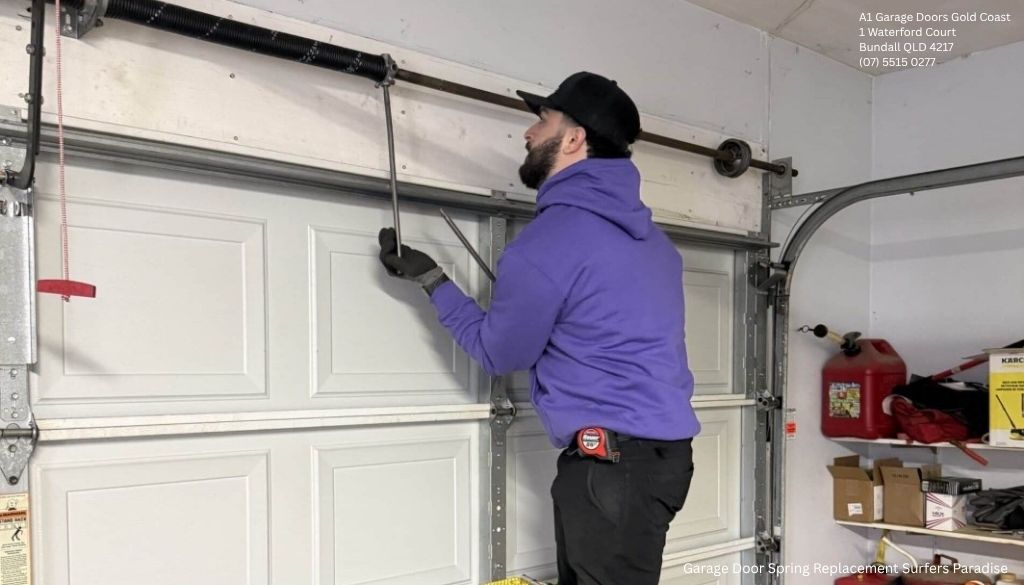
Garage door spring replacement is one of the most common example. Many home owners seek out a video, order springs online, and presume careful job will certainly suffice. Occasionally they get through it. Often they do not. The actual issue is that garage door springtimes are not just parts, they are filled mechanical parts matched to a specific door weight and height. The winding process requires the right bars, the proper variety of turns, safe and secure collection screws, and a solid understanding of equilibrium testing. Using screwdrivers as opposed to winding bars, which still takes place more often than it should, is among those choices that can go wrong instantly.
Cables develop a similar incorrect sense of simplicity. A torn wire resembles a rope that needs changing. In technique, it becomes part of a system under lots, linked into drums, bottom fixtures, and springtime tension. If a cable has come off one side, there is generally a reason. It might be a broken springtime, a curved track, a taken roller, or an unequal door. Changing or resetting the wire without identifying the reason frequently produces a repeat failure.
Garage door opener issues also have layers. If the opener motor hums and the door hardly moves, the root trouble may not be the opener whatsoever. It could be a damaged springtime, stripped equipment, locked cart, misaligned track, or door imbalance. Changing a garage door opener without resolving a hefty door is expensive and short-term. A brand-new opener can not make up for negative technicians for really long.
A useful means to decide
When home owners ask me whether they must attempt a repair, I usually tell them to judge the scenario by threat, not confidence. Self-confidence is unstable. Danger is concrete.
If the repair work can be done with the door fully shut, without touching tensioned components, and without placing any type of part of your body under a put on hold tons, it may be an affordable DIY task. If the fixing involves taking a break springs, loosening up bottom braces, resetting cords, correcting the alignment of tracks that are sustaining a loaded door, or forcing activity when something is jammed, it is time to stop.
Here is a beneficial rule of thumb for the typical family. If you can securely detect the concern with a flashlight, a ladder, and the owner's guidebook, you might be able to repair it. If the following action calls for specialized bars, clamps, deep mechanical judgment, or guesswork about springtime stress, you are outside secure do it yourself territory.
The concealed price of obtaining it almost right
A garage door does not have to stop working completely to come to be harmful. A repair work that is simply "close sufficient" can shorten the life of expensive components and develop a postponed problem.
Take door equilibrium. If the springtimes are a little mismatched after a repair work, the opener may still raise the door. That can mislead a home owner right into assuming the task succeeded. Yet an opener that has to combat additional weight every cycle wears gears, stress the rail, and overheats the electric motor. Over a couple of months, a small springtime mistake develops into a much bigger bill.
Misaligned tracks produce comparable difficulty. A track can be close sufficient for procedure while still creating rollers to wear erratically, pivots to bind, and the door to drink itself loose with time. The home owner listens to more noise, adds a lot more lube, and misses out on the actual issue.
This issues much more with garage door setup. New doors need to be matched to the opening, supported appropriately, secured correctly, and well balanced precisely. A poor setup might look penalty on day one and reveal its defects in the initial season of temperature swings. I have seen doors with bad leading section placement leakage water and chilly air, and new installs with under-sized springs that made the opener work much harder than it should. Specialist installation is not nearly rate. It is about obtaining the system right from the start.
Safety features aid, but they do not make high-risk fixings safe
Modern openers consist of picture eyes, auto-reverse systems, rolling-code remotes, and manual release features. Those are valuable securities, but they are typically misinterpreted. The auto-reverse attribute, as an example, protects versus entrapment during closing. It does not make spring work risk-free. Photo eyes can protect against a door from closing on a youngster or animal. They do not prevent a wire from whipping loosened throughout a failed repair service attempt.
The manual release cable is an additional example. It exists so you can detach the opener and operate the door by hand throughout power blackouts or troubleshooting. Yet if the spring is damaged and the door is heavy, drawing the launch without recognizing the equilibrium can leave you holding a door that wants to knock down. I have actually enjoyed individuals learn that lesson the tough way.
Safety systems are a layer, not an alternative to mechanical control.
When calling a professional is plainly the much safer choice
There are situations where reluctance simply wastes time. If any one of the following are true, specialist help is the much safer path:
The springtime is broken or you think a springtime failure. A lift cable is frayed, loose, or off the drum. The door is crooked, off track, or goes down when partially opened. The base brackets, torsion system, or birthing plates require work. The opener stress, stalls, or turns around since the door is as well heavy or unbalanced.That listing covers a lot of the risky call both property garage door repair and light business garage door repair. It is not dramatic, just functional. When force and kept power are entailed, know-how matters.
What a specialist brings that a video clip cannot
Skill is just component of the solution. Devices and pattern recognition matter just as much.
A skilled service technician can frequently hear a problem prior to completely seeing it. The sound of a completely dry bearing, a chain set also limited, a loosened joint, or a spring that has actually stumbled gradually stands out when you have actually worked around adequate doors. That sort of experience shortens medical diagnosis and stops the usual mistake of replacing the incorrect component first.
Professionals also bring the best hardware. Springs are chosen by cable size, inside diameter, length, and door weight requirements, not by rough visual comparison. Rollers come in various stem sizes and products. Track spacing, drum types, cable sizes, and opener compatibility all matter. A homeowner frequently shops by appearance. A service technician View website usually shops by specification.
There is an additional advantage people do not constantly think of: accountability. Reliable companies support their job. If the door is still out of balance, if the opener force requires a final tweak, or if a freshly mounted part exposes a related weakness, you have someplace to call. That deserves greater than individuals confess, especially when the garage door is the primary day-to-day entryway to the home.
The money concern, honestly
DIY is typically framed as the less expensive route, and often it is. If all you need is lube, a substitute remote, fresh batteries, brand-new weather seal, or sensing unit alignment, doing it on your own can save a service telephone call and make ideal sense.
But expense comparisons get distorted when individuals overlook threat and remodel. A house owner may save cash theoretically by attempting Garage door spring replacement alone. If the springtimes are incorrect, the winding is irregular, the opener gets damaged, or a car panel obtains dented by a falling door, the savings disappear rapidly. Even without injury, one stopped working attempt can result in paying for emergency situation service plus the components you currently bought.
Professional work also often tends to be a lot more efficient in identifying the whole system. A professional dealing with a garage door opener issue may see split hinges, aging rollers, and a door that is running five pounds too heavy on one side. Repairing those together can protect against serial failings. Do it yourself often treats signs individually, which feels less costly up until the second and third problems show up.
For businesses, the computation is even more direct. Business garage door repair commonly influences staffing, filling routines, safety and security, and customer access. Downtime can set you back much more than the repair service itself. In that setting, attempting to conserve cash with improvisated fixes usually backfires.
The jobs that make sense for cautious homeowners
For home owners who wish to stay included without entering dangerous territory, this is the zone I recommend:
Clean and align picture eye sensors. Lubricate joints, rollers, springs, and bearings with the proper product. Replace remote batteries, keypads, and some wall surface controls. Inspect climate seals and change used base or boundary seal material. Test door balance only if you understand the hand-operated launch and the door is or else operating normally.That last factor deserves caution. An equilibrium test can be beneficial, however just on a door that is currently relocating normally and only with the opener disconnected according to the handbook. Elevate the door partway and see whether it stays in location. If it wanders hard up or down, reconnect the opener and call a pro. Do not begin changing springtimes since the examination informed you something is off. The examination is for medical diagnosis, not license.
A few real-world scenarios
A property owner hears a loud pop and locates the door opens up a couple of inches, then stops. The opener is still powered, the rail steps, and the remote jobs. This is traditional spring failure region. The more secure selection is specialist service. Remaining to run the opener can stress out gears or bend hardware.
Another house owner notices the door will certainly not close unless they hold the wall surface switch down. Oftentimes, that points to photo eye misalignment or sensor blockage. Wipe the lenses, inspect the brackets, make sure both sign lights reveal regular condition, and clear anything in the beam of light. That is a practical do it yourself very first step.
A third property owner sees one side of the door hanging less than the other. Possibly a cable came off, maybe a roller left the track, maybe a spring concern created the door to rack. In either case, do not keep biking it. An uneven door is unsteady. That is a service call.
Then there is the usual "brand-new opener" mistake. Somebody replaces the garage door opener due to the fact that the old one struggled, just to uncover the brand-new unit battles too. The actual problem was an unbalanced door or worn springtime system all along. This takes place frequently adequate that I seldom presume the opener is the main failure up until the door itself passes a balance check.
How to pick the best service company
Not all expert assistance is equivalent. The much safer selection is just safer if the person doing the job recognizes the trade.
Look for a business that deals with your type of system routinely, describes the trouble clearly, and is willing to compare immediate repair services and optional upgrades. Great service technicians do not need theatrics. They can show you the worn component, discuss why it fell short, and tell you what occurs if you hold off the repair service. That kind of ordinary talk is typically a much better indicator than a difficult sales pitch.
For garage door installment, inquire about insulation alternatives, cycle ratings for springtimes, opener compatibility, and guarantee insurance coverage. For industrial garage door repair, ask whether they service the certain door type on your building, such as sectional steel, rolling steel, or high-speed doors. Accuracy issues because these systems are not interchangeable in technique, even when they look similar from a distance.
The safer option, the majority of the time
For low-risk upkeep and straightforward troubleshooting, DIY can be reasonable and cost-efficient. Home owners need to know how to tidy sensors, lubricate moving components, check for obvious obstructions, and recognize standard garage door opener features. That type of participation often helps capture tiny problems before they grow.
But once a repair service includes spring tension, cords, architectural positioning, hefty training, or unpredictable medical diagnosis, professional garage door repair comes to be the more secure choice by a wide margin. That is specifically real for Garage door spring substitute, off-track doors, significant opener issues linked to balance, and almost all commercial garage door repair situations.
A garage door is not simply another ease device. It is a crammed mechanical system that works hard, frequently a number of times a day, with really little space for careless improvisation. Respecting that fact is what maintains a small trouble from ending up being a serious accident.